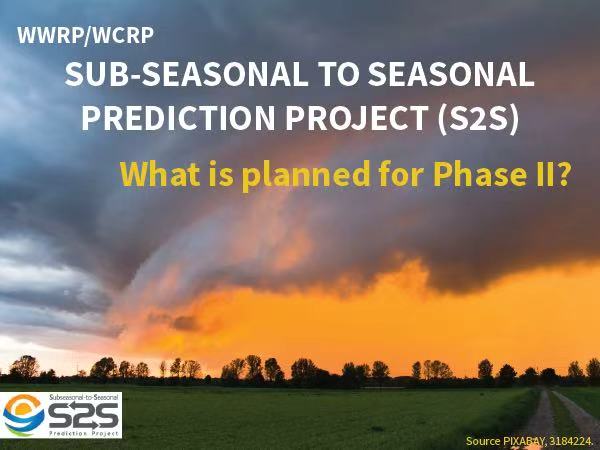
1.S2S Newsletter No. 23 (August 2023): Announces the writing of the SAGE Implementation Plan and nomination of pilot partners, marking the transition from the S2S Project to SAGE under the 2024–2027 WWRP Implementation Plan.
2. S2S Newsletter No. 24 (December 2023): Features an article titled “Sub-seasonal to seasonal Applications for Agriculture and the Environment (SAGE),” outlining SAGE’s aim to make sub-seasonal forecasts more useful, usable and used for decision-making.
3. Woolnough & Marchezini (2023): “Sub-seasonal to seasonal Applications for Agriculture and the Environment (SAGE),” a ResearchGate–hosted PDF summarizing SAGE’s objectives and steering group membership.
4. Victor Marchezini (Dec 2023): Presentation “SAGE – Examples of some research actions” from the INPE December workshop, detailing pilot application case studies and co-production approaches.
5. WSRP/WCRP S2S Phase II Report (2023): Proposes the SAGE project as a new 5-year WWRP sub-project, outlining its research foci and connections to the S2S database.
6. “Proposed Project: SAGE (S2S Applications for Agriculture and Environment). Research Foci” (2022): Slide deck from a WWRP/WCRP Future Perspectives workshop, listing SAGE’s science priorities and sectoral targets.
7. Presentation “SAGE: Sub-seasonal Applications for Agriculture and Environment” (2022): Workshop abstract highlighting SAGE’s enhanced physical science base and the development of tailored forecast products.
8. Vitart & Robertson (2025): “The WWRP/WCRP S2S project and its achievements,” Bulletin of the American Meteorological Society, which notes that in 2024 WWRP launched SAGE to build on S2S legacies and advance forecast applications.
9. WMO Magazine (2025): “WMO Research Programmes, Promoting Science for Action” article, describing SAGE’s direct contributions to SDGs by making 2-week to 2-month forecasts actionable for agriculture, energy, health, water and DRR.
10. Int-Res (2025): PDF “Launch of the global preharvest crop forecast of climate-induced …” which includes a section on “Project Sub-seasonal Applications for Agriculture and Environment (SAGE) 2024–2028” and its integration with crop forecasting.