International Symposium on Enhancing Sub-Seasonal Predictions with Alfor Early Warnings and Working Meeting of WMO SAGE and TMR
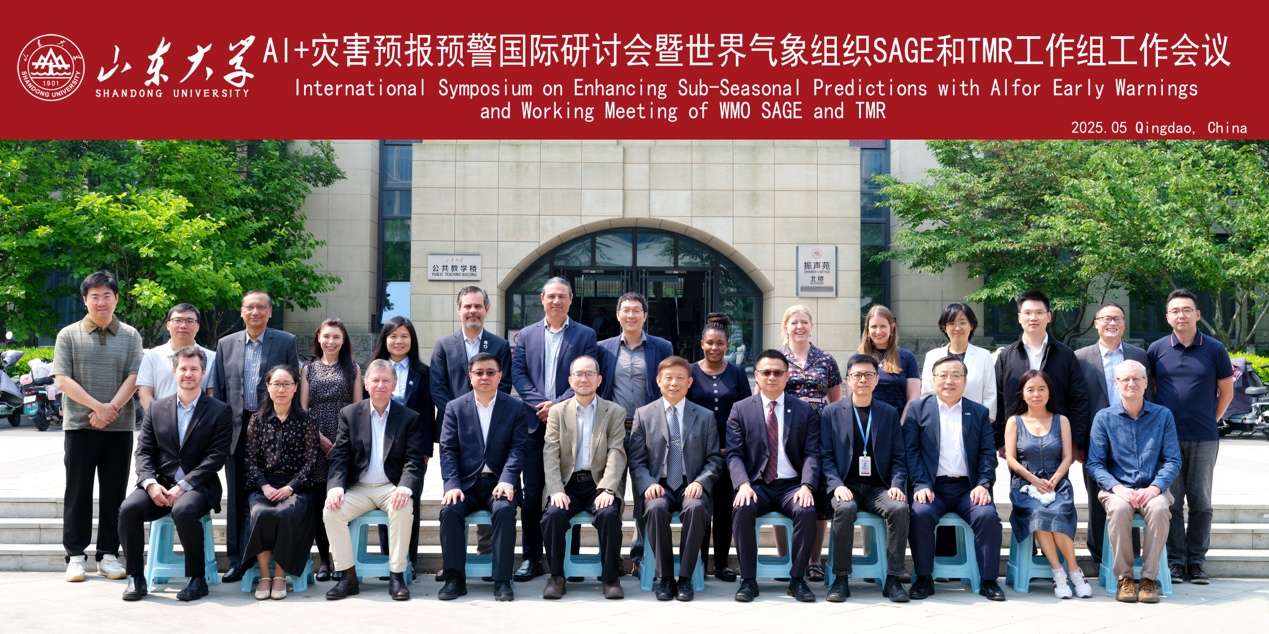
On 26 May 2025, the World Meteorological Organization (WMO), in partnership with Shandong University, hosted the “International Symposium on Enhancing Sub-Seasonal Predictions with Alfor Early Warnings and Working Meeting of wMO SAGE and TMR” at Shandong University’s Qingdao Campus. Representatives from the WMO World Weather Research Programme (WWRP) Scientific Steering Committee, led by Kunio Yoneyama, joined Xu Xiaofeng, President of the China Meteorological Service Association and former Vice-Director of the China Meteorological Administration, and Li Shengying, Vice-President of Shandong University Qingdao Campus, for opening remarks. The ceremony was chaired by Ma Ben, Dean of the School of Political Science and Public Administration at Shandong University.
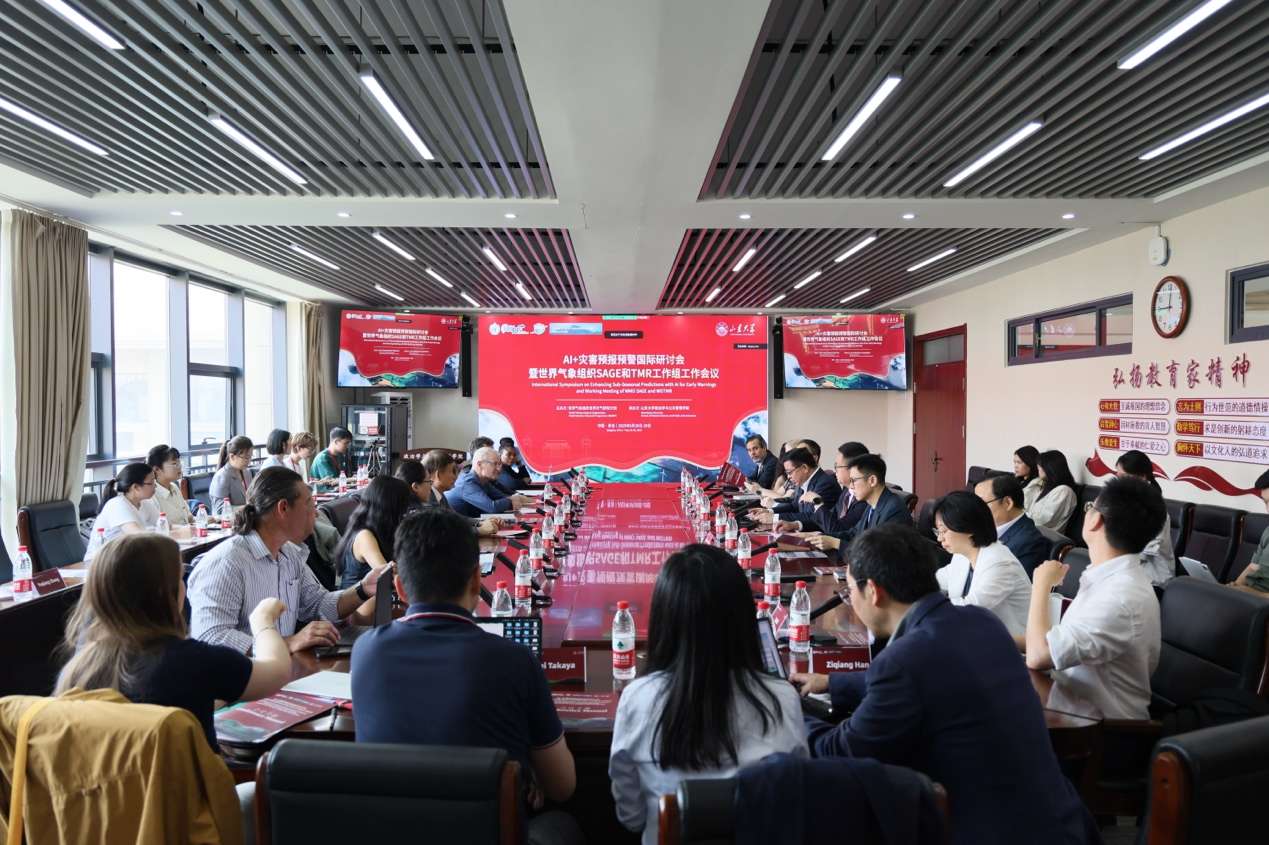
Kunio Yoneyama presented WMO’s research initiatives under the WWRP framework and expressed his hope that the symposium would foster academic exchange and international collaboration. Xu Xiaofeng outlined the global challenges posed by climate change and meteorological disasters, shared China’s experience and best practices, and called for building a meteorological disaster prevention and mitigation community through international partnership and technological innovation. Li Shengying reviewed Shandong University’s development, highlighted the distinctive strengths of its Disaster and Emergency Management discipline, and discussed approaches to cultivating talent for global governance and international organizations, stressing the need to deepen international cooperation to meet global challenges.
Following the opening, a high-level forum addressed three key themes: the application of artificial intelligence and machine learning in sub-seasonal to seasonal prediction; the use of sub-seasonal to seasonal forecasts in sectoral services; and the role of AI and machine learning in disaster prevention, mitigation, and early warning. Experts delivered keynote presentations and engaged participants in lively discussions on topics such as early-warning models and risk assessment.
Kunio Yoneyama introduced WMO’s work on global early warning systems, the WWRP, the Working Group on Tropical Meteorology Research (TMR), and the Sub-seasonal to Seasonal Applications for Agriculture and Environment (SAGE) working group. Dr. Zhong Xiaohui from Fudan University’s Institute for AI Innovation and Industry shared “Fuxi: A Meteorological Mega-Model—A Machine-Learning System for Data-Sparse Regions Beyond Traditional Global Forecasting.” Professor Dewald van Niekerk of North-West University, South Africa, presented a multi-hazard early-warning framework for the Southern African Development Community. Researcher Li Chao of the China Meteorological Administration’s Public Service Center reported on “Text as Data: Large-Language-Model-Driven Disaster-Warning Datasets and Optimization.” Dr. Li Tao from Shandong University’s School of Environmental Science and Engineering discussed “Statistical and Machine-Learning Methods for Air-Pollution Forecasting: Interpreting Multiscale Time-Series Features and Physicochemical Processes.” FAO’s Catherine Jones spoke on “Anticipatory Action—Using Machine Learning to Reduce Climate Risks in Agriculture.”
Ms. Liu Yunyun, Deputy Director of the Climate Prediction Division at the National Climate Center, presented “Monthly to Seasonal Forecasts of Global Wind and Solar Power Generation Capacity.” Dr. Chloe Fletcher of the Barcelona Supercomputing Center described “Integrating Sub-seasonal to Seasonal Forecasts into Climate-Sensitive Health Risk-Warning Systems.” ECMWF scientist Steffen Tietsche reported on “Developing Data-Driven Sub-Seasonal to Seasonal Prediction at ECMWF.” Researchers Kieran Hunt and Aheli Das from the University of Reading presented “Revealing New Dynamical Relationships Governing Monsoon Low-Pressure Systems with Explainable Gradient-Boosted Decision-Tree Ensembles” and “Improving India’s Sub-Seasonal to Seasonal Wind-Speed Forecasts with Statistical and AI/ML Methods,” respectively.
During a closing roundtable on “Bridging the Gap from Science to Application,” Dr. Masilin Gudoshava (ICPAC, Kenya), Associate Professor Emma Hudson-Doyle (Massey University, New Zealand), Dr. Victor Marchezini (INPE, Brazil), and Professor Ziqiang Han (Shandong University, China) engaged in in-depth discussions on applying early-warning forecasts to disaster risk reduction and emergency response.
More than 300 experts and students from Shandong University—and from over 30 countries and regions, including Argentina, Australia, Brazil, the USA, South Africa, Japan, Switzerland, New Zealand, India, the UK, Spain, Kenya, Venezuela, Thailand, Somalia, Singapore, Sudan, Pakistan, Peru, the Netherlands, Nigeria, Namibia, Jordan, Italy, Indonesia, Ghana, Ethiopia, Egypt, Algeria, Canada, Belarus, Bangladesh, and others—participated both in person and online.
From 27 to 29 May, the WMO WWRP SAGE and TMR working groups convened at the School of Political Science and Public Administration, Shandong University Qingdao Campus. Over the three‐day meeting, they reviewed WMO’s upcoming work plan for 2024–2028—particularly the objectives and milestones for the two working groups—summarized progress and achievements from the past year, and held detailed discussions on strengthening collaboration between working groups, enhancing cooperation between WMO and other UN agencies and research institutions, and tailoring meteorological products at different timescales to serve agriculture, energy, health, and disaster risk reduction. The meeting concluded with recommendations to inform future WMO policies and operational guidelines.